Cameron Carpenter has become a common name in the world of organ performance today. Known for his virtuosic playing, his glittering, skin-tight costumes, and his advocacy of digital organs, Cameron is an accomplished performer as well as an eccentric one, even by the standards of the world of organists (yes, I openly admit that we are a weird bunch). He hails originally from Pennsylvania, studied organ for six years at the Juilliard School of Music, and is the first organist ever to be nominated for a Grammy with his first album, "Cameron Carpenter: Revolutionary." (The first organist ever to WIN a Grammy was Paul Jacobs with his recordings of Messiaen's "Livre du Saint Sacrement").

The title of his album, "Revolutionary," could be applied to his point of view regarding the organ.
First, though, some background information. Organists have a rather unique relationship (or perhaps lack thereof) with their instrument. Most performers, such as Yo-Yo Ma, Joshua Bell, or Hilary Hahn, have one instrument which they play. They know the instrument intimately from years of practice and performance. Organists don't have this luxury for multiple reasons. First, there are physical limitations: we have to travel to our instrument. We play what is available to us in practice as well as in performance. For this reason, we don't play one instrument, but many. This is also partially true of pianists, but to a much lesser extent.
Secondly, no two organs are exactly alike. (No two instruments are exactly alike, either, but these differences are subtle compared to the differences in organs). The instrument can be an actual pipe organ, or it can be a digital organ, in which all the pipes are "pre-recorded." There are a host of colors/sounds that designers/builders can choose to include or omit. The range of pitch can vary as well (such as whether or not to include a 32', and if so, how many). The individuality of the instrument, regardless of whether not it is digital, is also partially due to the space in which the organ resides. The acoustics of the room play a major role in how the organ sounds and how it should be played. If there is carpet and a lot of fabrics in the room, which absorb sound, (this is what we musicians like to call a "dead" space) the organist should use a different touch than if he were performing in a vast cathedral such as St. Stephansdom in Vienna.
These characteristics/limitations create a host of challenges/problems for organists. A versatility is required of the organist that is not required of most other musicians. How they play and how they register a piece for one organ is not guaranteed to work on another, perhaps because one or more pipes refuse to sound, they don't have the same amount of pipes, or some of the reeds are out of tune. For this reason, the organist must spend a considerable amount of time familiarizing himself with and adjusting to the individuality of the instrument. To Cameron, who has a rigorous concert schedule taking him all over the world, this is valuable time that could be spent practicing. Cameron says, "I'm extremely lucky and very, very grateful to have the ability and the demand to play in all these places. But consequently it's very difficult to really feel that I know any single instrument, and I almost never do, and I'm very outspoken about what a scandal that is, and I feel that most of all. It's unbelievably stressful for me. But I also feel increasingly uncomfortable with the idea of performing for huge audiences and people who are paying money to hear me when I am effectively, at least by my own standards, unprepared or underprepared, usually severely underprepared in some way." He also remarked in a presentation given at Michigan University in September 2010, "I've never believed that the organ should be the ultimate authority to which the player submits. I think it should really be the other way around."Cameron hopes to find a solution to this predicament in a digital organ which he has personally designed: an organ that is run using massive parallel-processing super computers. Using computers to capture the sound of pipes, he has sent out a team which is combing organs for the best sounds to record. Each stop equals over a terabyte of data, which is then routed through a system similar to that of a physical pipe organ. This instrument will possess five keyboards, "because I've never felt that organ playing has anything to do with less than five keyboards," and a rather unique pedalboard. The typical organ has a pedalboard of 32 notes from C to G (going from left to right, if you will). Cameron wants to raise the level of what's expected of an organist's feet to that which is expected of the hands. "I think it's interesting to try and expand the pedal board. I'm a big believer in taking music that's not for the organ and putting it on the organ, starting with Chopin's etudes, which are played a lot by the feet." For these challenging works (meant as teaching pieces to hone pianists' skills), he prefers a 46-note pedal board, with seven notes added on either side. This would expand the range from F to D.
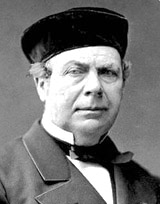 |
| Aristide Cavaille-Coll (1811-1899) |
Cameron hopes to give more artistic freedom to the organ and organists through his efforts, which have been met with mixed reactions. I am not doubting the credibility of his intentions. I believe that innovation in organ building ought to be encouraged. The organ has evolved throughout the centuries through the efforts of both great organists and organ builders, each influencing the other. One such organ builder was Aristide Cavaille-Coll, a Frenchman of the late Romantic period who modernized and expanded the musical possibilities of the organ. He gave organists more musical colors to explore so that the organ now had a symphonic aspect unknown to the organists of yesteryear. (However, it must be articulated that the organ was and is not a symphony and you cannot compose for the organ the way you would for a symphony). Nevertheless, now the organ could behave similar to a symphony in both the replication of specific instruments and in dynamics. Cavaille-Coll and other organ builders of the day combined engineering and art, building each organ specifically for the space in which they were to reside. These organs also served to inspire many composers of the Romantic period: Cesar Franck, Charles-Marie Widor, Louis Vierne, etc. to compose for the organ. In short, Cavaille-Coll tried and succeeded in giving more artistic freedom to organists.
I would answer that what determines the success of innovation is the quality of the art which is produced on the instrument -- specifically the quality of the sound or the accoustics. Is the sound or the musicality going to be severely compromised for the sake of the performer's convenience? A digital/virtual organ needs to be able to produce a variety of sounds -- the sounds of a Baroque as well as a Romantic organ and even a perhaps even a theater organ. It also needs to provide or demonstrate an excellent representation of these sounds. For example, it ought to replicate the "chinck" sound of a Baroque flute, or the richness of sound experienced when listening to a Cavaille-Coll organ, such as the one still residing in the Church of St. Ouen in Rouen, France. It seems to me that Cameron is doing his utmost to ensure that his instrument is both versatile and possesses the best sounds.
However, I question if he will be able to replicate the beautiful accoustics which are most conducive to the music of a pipe organ -- in other words, a beautiful space like a concert hall or a large cathedral. Music performed in such a room has a richness to it that disappears in a dead space. When one plays the organ, one is not just playing the instrument. In the words of my former organ professor, he is also "playing the room." I receive the most satisfying experience of the organ when I play it in a room that makes the instrument sound like a million bucks. However, if Cameron desires to take his organ wherever he goes -- from Las Vegas to prisons -- the room is going to be different for nearly every performance. Some are going to be dead while others will be wonderful. What is my difficulty with this? While I applaud Cameron's desire to give his audience a satisfying experience of the organ, I question whether or not he will be successful if he is playing the organ in a dead room which lacks the accoustic richness of a space like Heinz Chapel in downtown Pittsburgh -- for example, his performance in the Greene Space. The latter performance still shows off his technical skills, but is it as aurally pleasing as this performance on the Trost organ in Waltershausen, Germany?
But perhaps that is my personal preference, and Cameron and audience members may prefer otherwise. One always has to keep in mind as an artist and a performer that beauty is flexible. There is never one way of interpreting a piece of music, and is never one way to build an organ. The means may change and evolve; however, the end must never be compromised: the making of good art!
I close with a quote about organ builders. (Forewarning, I am a serious quote-geek!)
"Pipe organ builders are not mass-production industrialists. They are artists, architects of sound, dreamers and creators." -- Agnes Armstrong.
